7 Visa Mistakes That Got Indian Students Rejected in 2025
By Nikhil Seth | Founder, UniGo Education
The numbers are stark. In 2025, 74% of Indian students who applied for a Canadian study permit were rejected — up from just 32% two years ago. The United States hit a 10-year high with a 41% F-1 visa denial rate. Australia reclassified India into its highest-risk visa tier. And yet, across thousands of counselling conversations at UniGo Education, we keep seeing the same patterns — the same avoidable mistakes — costing deserving students their dreams.
This isn't about unfair systems. This is about preparation. Here are the seven mistakes we've seen derail Indian students in 2025, and exactly what you need to do differently.
The State of Indian Student Visas in 2025
Before we get into the mistakes, the data deserves attention. This year, Indian student visa applications have faced unprecedented scrutiny across every major destination:
Canada: 74% rejection rate for Indian applicants (up from 32% in 2023)
USA: 41% F-1 denial rate — a 10-year high; F-1 issuances to Indians dropped 44% in the first half of 2025
Australia: 48% fewer student visas granted to Indians; India reclassified to Assessment Level 3 (highest-risk tier) effective January 2026
United Kingdom: A relative bright spot at 96% approval rate — proof that strong applications still win
What changed? Governments tightened documentation scrutiny, added social media screening, and cracked down hard after the 2023 fake-admissions scandal in Canada involving over 1,500 fraudulent offer letters. The bar is higher. But it's still very much clearable — if you know what not to do.
Mistake #1 — Sudden Large Bank Deposits Without Explanation

What went wrong: A student showed a bank balance of ₹25 lakhs — but only for the past 45 days. The previous three months showed a balance of ₹2 lakhs. Red flag. Visa refused.
Visa officers are trained to spot "fund parking" — the practice of temporarily depositing large sums to meet financial requirements, then withdrawing them post-visa. A suspiciously large recent deposit with no traceable income source is one of the most common triggers for rejection in 2025, especially for Canada and Australia.
The fix: Your financial trail matters more than your balance sheet snapshot. Show 6 months of consistent, explainable bank statements. Link funds to salary slips, ITRs, business income, or sanctioned education loans. If there's a large transfer, have a gift deed or documented transfer in place. Funds must be genuine, not borrowed for show.
Mistake #2 — A Generic, Copy-Pasted Statement of Purpose

What went wrong: The SOP spoke glowingly about "pursuing higher education in a world-class institution to enhance career prospects." It could have been written for any student, any university, any country. It was rejected accordingly.
The SOP (Statement of Purpose) is your visa interview on paper. In 2025, immigration officers expect laser-sharp specificity — the exact faculty you want to work with, the particular lab or research cluster your program offers, and how this specific course at this specific university fits a clearly articulated 5–10 year career roadmap back in India.
The fix: Customise every SOP. Name the professors. Cite the curriculum modules. Explain why this university — not just this country. Connect it backwards to your academic journey and forwards to your professional ambition. A well-crafted SOP isn't a marketing brochure; it's a logical argument. Let it be one.
Mistake #3 — Failure to Demonstrate Intent to Return to India

What went wrong: Under Section 214(b) of the US Immigration and Nationality Act, every F-1 applicant is presumed to be an intimmigrant unless they can prove otherwise. A student with no clear career plan in India, no family ties, no job or business to return to — was refused.
This is the single biggest reason for F-1 visa rejections from India, and it becomes increasingly problematic when applicants cannot articulate why India needs them back after their studies.
The fix: Build a narrative of return. Articulate a specific career goal in India — joining a family business, contributing to a domestic sector, returning to a sponsoring employer. Show community ties, property ownership, family responsibilities. If you have a job offer or internship lined up in India post-graduation, document it. The officer must be convinced you're a student going to study — not an immigrant going to stay.
Mistake #4 — Unexplained Academic Gaps or Inconsistencies

What went wrong: A student had a 2-year gap between undergraduate and postgraduate applications. No explanation was offered. The application was flagged and refused.
Academic gaps — whether between school and graduation, between graduation and work, or between work and the planned course start — are not automatically disqualifying. What's disqualifying is leaving them unexplained.
The fix: Every gap requires a narrative. Did you work in the family business? Prepare for competitive exams? Manage a health issue? Care for a family member? Document it. A brief explanatory letter with supporting evidence (certificates, medical records, affidavits) transforms a suspicious gap into an understandable life event. Don't leave white space for the officer to fill with assumptions.
Mistake #5 — Mismatched or Incomplete Documentation
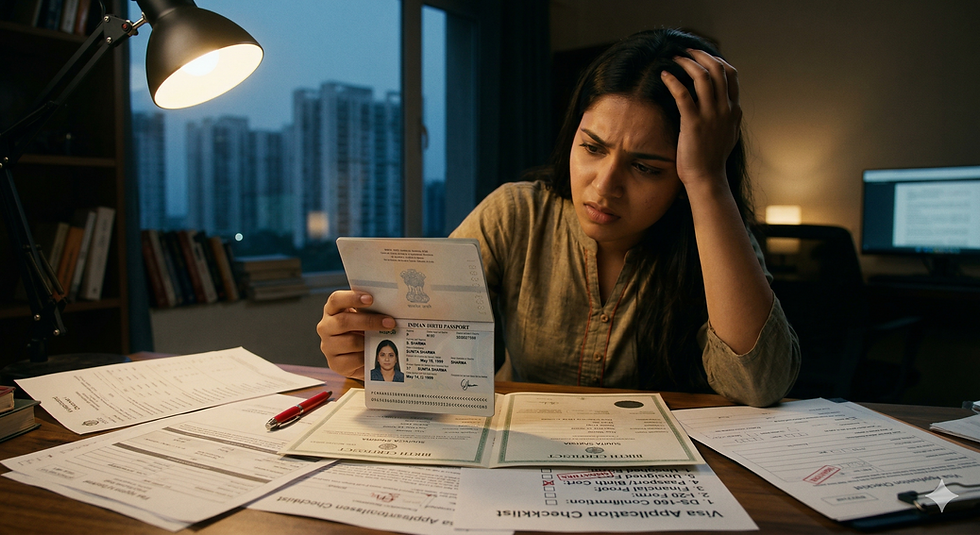
What went wrong: The financial documents showed one address. The academic certificates showed another. The offer letter mentioned a start date that didn't match the visa application. Three mismatches — one rejection.
In an era of heightened scrutiny, inconsistencies in applications are treated as integrity issues. Whether it's a name spelling discrepancy, a misaligned date, or missing supporting documents, incomplete or inconsistent applications are routinely refused without further investigation.
The fix: Before submission, conduct a full document audit. Cross-check every name, date, address, and figure across all documents. Ensure your offer letter, financial proof, SOP, and academic records tell one consistent, coherent story. Have an experienced counsellor review your file — the cost of a missed check is a visa denial, a lost semester, and months of waiting.
Mistake #6 — Social Media Footprint Contradicting Visa Intent

What went wrong: A student's public Instagram account showed posts about "finally leaving India for good" and "not coming back." The US consular officer, now required to review publicly available social media as part of the vetting process, found the posts. Visa denied.
In 2025, the US Department of State formally expanded social media screening for all student visa applicants. What you post publicly is now fair game in your visa assessment.
The fix: Audit your digital presence before applying. Set personal accounts to private. Remove or archive any posts that could suggest immigrant intent, financial misrepresentation, or content inconsistent with your stated academic purpose. Keep your professional profiles (LinkedIn) current and aligned with your stated career narrative. Your online presence is now part of your visa application — treat it as one.
Mistake #7 — Using Unverified Agents or Fraudulent Documents

What went wrong: The 2023 Canada fake-admissions scandal didn't go away — its consequences raged through 2025. Hundreds of Indian students, unknowingly or knowingly, used fraudulent offer letters sourced through unscrupulous agents. Canada's crackdown, which included mass rejections and deportations, directly fueled the 74% rejection rate for Indian applicants in 2025.
Using agents who promise "guaranteed admissions" or offer to "manage documentation" without transparency is not just ethically wrong — it is catastrophically risky. Immigration authorities share data. A fraudulent application in 2025 can bar you from reapplying for years.
The fix: Work only with registered, reputable education consultants. Verify your offer letter directly with the university's international admissions office before submitting your visa application. If an agent promises you something that sounds too easy — it likely is. At UniGo Education, every offer letter and document we facilitate is verified end-to-end before it reaches a visa officer.
What This Means for You
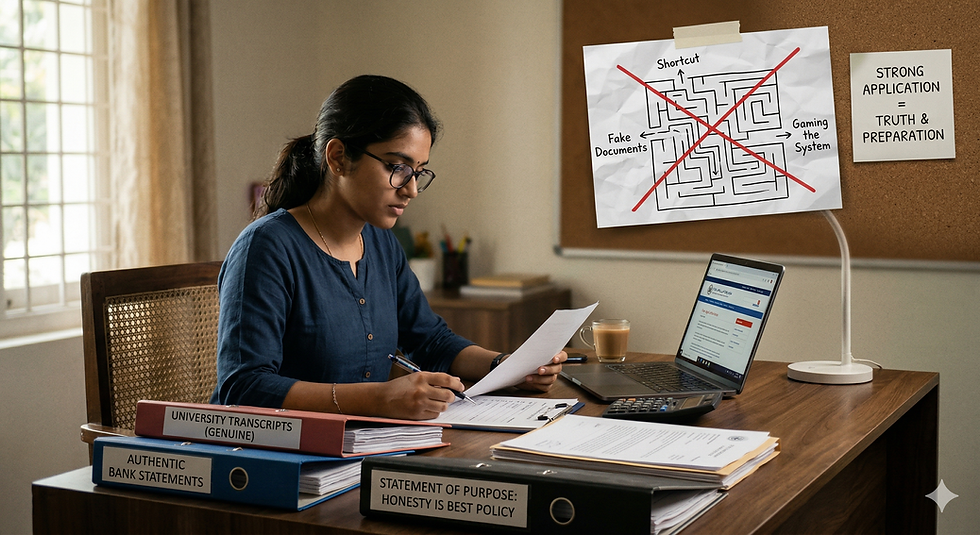
The landscape for Indian students going abroad has never been more scrutinised. But it has also never been more navigable — for those who apply with integrity, preparation, and the right guidance.
The students who got rejected in 2025 didn't fail because the systems were unfair. Most of them failed because they didn't know what the systems were looking for. Now you do.
A strong visa application is not about gaming the system. It's about presenting the truth — completely, consistently, and compellingly.
At UniGo Education, our visa advisory framework is built around exactly this principle. We review every document. We challenge every SOP. We audit every financial trail. Because when you've worked this hard to get an admission offer, the visa should never be where your journey ends.
Frequently Asked Questions?
Q: What is the student visa rejection rate for Indian students in Canada in 2025?
Canada's study permit rejection rate for Indian applicants reached 74% in 2025, up from 32% in 2023, driven by stricter financial scrutiny and a crackdown following the 2023 fake offer letter scandal.
Q: What are the most common reasons for Indian student visa rejections in 2025?
The top reasons include insufficient or unexplained financial proof, a weak or generic Statement of Purpose, failure to demonstrate intent to return to India, unexplained academic gaps, document inconsistencies, problematic social media content, and use of fraudulent documentation or unverified agents.
Q: Why did Australia reclassify India for student visas?
Australia moved India to Assessment Level 3 — its highest-risk visa category — effective January 2026, citing integrity concerns including fraudulent financial documents and misrepresented student intentions.
Q: Which country has the best student visa approval rate for Indian students in 2025?
The United Kingdom has the highest approval rate for Indian student visa applicants in 2025, with approximately 96% of applications approved.
Q: How can Indian students avoid visa rejection in 2025?
Key steps include showing 6 months of consistent, traceable bank statements; writing a highly personalized SOP; documenting ties to India; explaining all academic gaps; ensuring all documents are consistent; auditing social media before applying; and working only with verified, registered education consultants.
Ready to make your application rejection-proof? Reach out to the UniGo Education team for a personalized visa readiness audit.


Comments